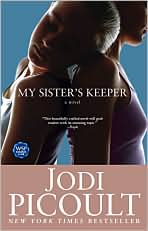
As a way to get myself in the habit of writing regularly, I'm going to try to post regularly to this blog over the next month or so. I've done a lot of media consumption (and subsequent reflection) this summer, so there's plenty of material percolating: stray thoughts on a book I just read, responses to what I see on TV, pretentious ideas occupying my higher brain functions as I distract myself with a video game. Having a rather high opinion of myself, my natural impulse is to turn to someone and share these stunning insights aloud, but all too often there is no audience readily available to witness my piercing observations. So I'll write them down instead.  I'll start with a book I read this past week, Jodi Picoult's My Sister's Keeper. Picoult has found one of those subjects both very relevant to real life yet fertile with dramatic potential that all writers and wannabe writers (like myself) wish they had thought of themselves. Anna Fitzgerald is conceived for the express purpose of serving as a marrow donor for her leukemic older sister, Kate. Prior to implantation, her embryo is genetically screened from a batch to be a perfect bone marrow match. Moments after her birth Anna's precious umbilical stem cells are whisked away to reinforce Kate's beleaguered immune system, and as she grows up Anna undergoes numerous operations, shots, and transfusions to prevent the lethal relapse of Kate's leukemia. Her parents love her and don't like to call her a "designer baby" but that is, effectively, what she is: Anna was selected and born for a purpose.
This scenario has in fact been seen in a number of families with a leukemic young child, which is part of what makes My Sister's Keeper such a potent novel. Picoult gives the narrative a jolt by opening with Anna, age 13 and unwilling to serve as a kidney donor for Kate, filing legal papers for medical emancipation from her parents. The subsequent legal controversy and family dysfunction propel the rest of the plot.
My Sister's Keeper was a enjoyable and brisk read - I might even go so far as to call it a "page-turner" if that phrase didn't have vaguely pejorative connotations - but still, I can't say I'm entirely satisfied with it. Ultimately I believe my disenchantment can be traced to the central emancipation plot. Picoult takes a scenario of enormous emotional complexity and dimension only to reduce it in order to make it fit a rather facile legal controversy. The life of a "typical" family with a designer donor baby is quite fascinating enough; there's no need for the author to contrive a rather outlandish legal gesture to inject some drama into the family dynamic. A more understated exploration of the unarticulated pity, obligation, and even occasional resentment of a typical donor/recipient relationship would probably have been far more provocative than what Picoult gives us here. Indeed, the overt recrimination and conflict the Fitzgerald family experiences as a consequence of Anna's dramatic decision is, if anything, quite familiar to us from other stories or own lives.
This impulse to "add the drama" is sadly evident throughout the book. Like many Picoult novels, My Sister's Keeper is resolved with a court case in the fourth act, but along the way it acquires one overwrought, contrived subplot after another. The older brother acts out by committing acts of arson which are then investigated by the fireman father. Anna's lawyer has a service dog for some unnamed disability that he's too proud to voice aloud. The court-appointed guardian ad litem still bears emotional wounds from a tumultuous high school romance with Anna's lawyer. Anna's mother is also an attorney and represents herself in court, cross-examining the father when Anna's lawyer calls him as a witness. (This produces perhaps the most cringe-inducing moment in the novel when the mother plaintively asks the estranged father, "When are you coming home?") These subplots leaden and encrust what is actually a very well-conceived relationship between Anna and Kate, who engage in movingly familiar rituals of sibling affection and bickering even as they together confront their extraordinary and unfamiliar challenges.
Unfortunately the relationship between Anna and Kate receives perhaps the least attention in the book as Picoult abandons it in order to pursue her many dramatic contrivances, and also to withhold information from the reader for a big reveal in the fourth act that is nevertheless rather predictable. There's also a second heavy-handed twist in the final pages that resolves everything a bit too neatly. My Sister's Keeper is being adapted into film - Nick Cassavetes, of The Notebook, is attached to direct - which does not surprise me; with its many twists, reversals, and romantic entanglements it is an exceedingly theatrical book - which is to say, unlike our less dramatic actual lives.
None of this is necessarily to imply that My Sister's Keeper is a bad book; it's far too well-written for that. The book brought me close to tears more than once - though on those occasions I couldn't shake the impression that I was being manipulated, as when a film produces a baby in peril or turns up the melancholy violin soundtrack. I might wish that Picoult treated her subject with a lighter touch and restrained herself to a purer, smaller story, but I must concede that she demonstrates tremendous craft with the story that she does choose to tell. I should also concede that I have the sort of jaded pomo taste that sees authorial contrivance everywhere and is predisposed to dislike Picoult's grander treatment of this subject in favor of a sparser, more minimalist approach.
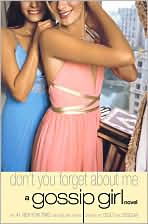
In the end I guess my feelings about the book come down to this: my copy of the book came in a very effete teal-and-peach pastel, with a cover photo of two tank top-wearing girls leaning against each other that resembles something from one of those faddish tween chick-lit "Gossip Girl" books. I like to pride myself the kind of progressive, educated person who is above arbitrary social constructions of gender and superficial masculine vanity, but I have to confess that when I was reading at the coffee shop I surreptitiously kept the book flat against the table surface, or read from underneath the table like a guilty elementary student. If, like me, you can't quite get past the cover, then the florid melodrama that obscures the fascinating central dilemma in My Sister's Keeper will probably prove an equally discouraging obstacle. Whether that's a failing of the book or of myself, I don't think I'm in a position to say.